


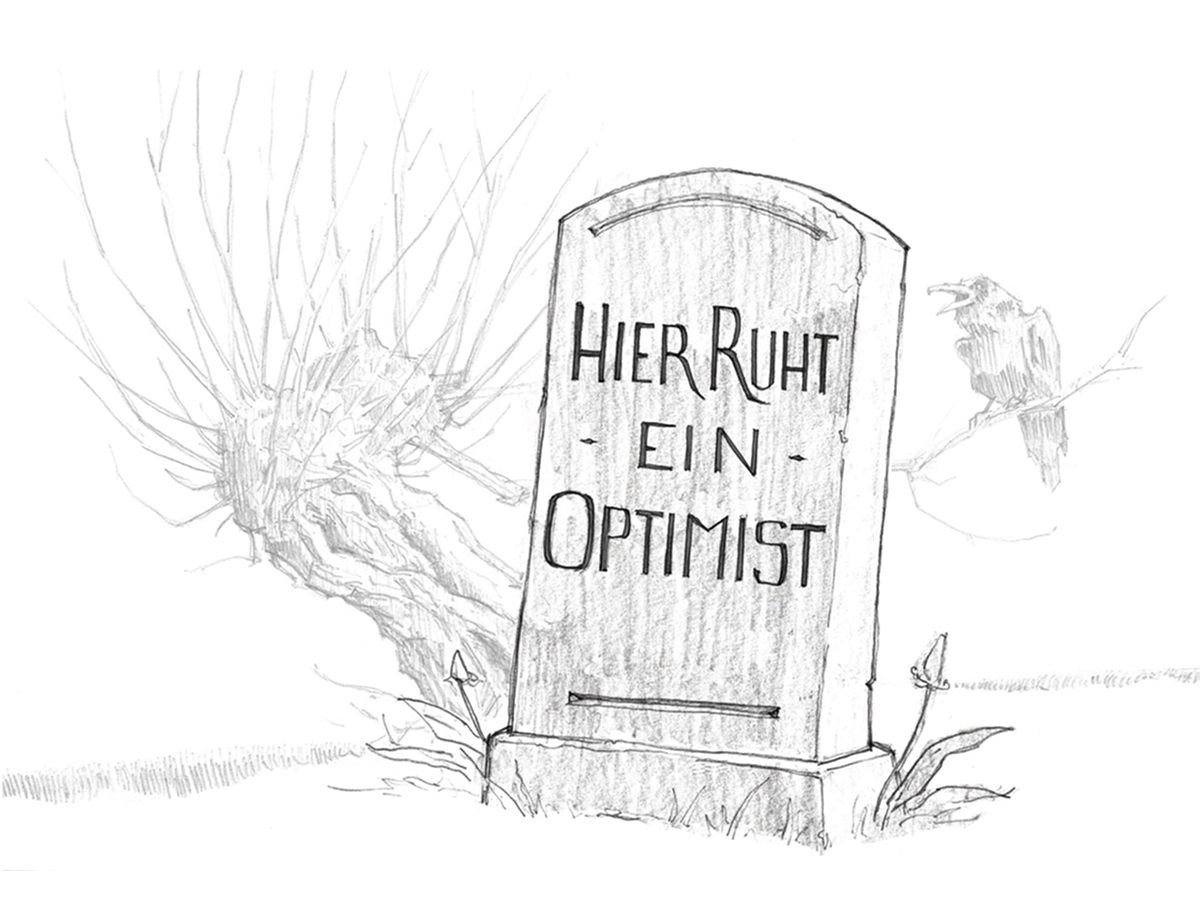
Optimism is a double-edged sword
You have no doubt heard a lot of wisdom about the power of positive thinking, such as „The glass is half full“, „Positive thinking is half the battle“ or „Faith can move mountains“. In fact, optimism helps especially in times of crisis and has also been well researched scientifically as a central key to resilience.
Optimism also gave me a lot of strength during my abduction in 2000 and was perhaps even my most important protective factor. (See also: Acceptance and optimism - the be-all and end-all of resilience) But I have also learned how dangerous positive thinking can be in crises. False optimism can be fatal and has already cost people their lives. Companies have also gone out of business because of positive thinking, such as Nokia and Kodak.
There are countless guides to positive thinking - and rightly so. But the art of positive thinking also lies in knowing and taking into account its limits and risks. And knowing what else is needed in addition to positive thinking to successfully overcome crises. That's what this article is about.
Example of kidnapping
During my abduction, I experienced the risks of positive thinking very impressively. Brief background: In 2000, I was kidnapped by Muslim rebels in Malaysia with 20 other people and held hostage in the Philippine jungle for 140 days.
The optimists among us hostages assumed that we would be released quickly: „It will take a week at most.“ But the deadline passed and we were still trapped. There were even repeated rumors: „You'll be free by the weekend!“ The optimists believed this and were already euphoric. But again, no luck! It went on like this week after week, for months. This life-threatening trembling was grueling for all the hostages, but the optimists were hit the hardest - because they kept falling from euphoria into depression, and some of them even developed serious suicidal tendencies.
If you like, you can get a live impression of this dangerous emotional state by watching minutes 36-38 watch this „National Geographic“ report of the kidnapping.
Disappointed expectations are therefore a risk of positive thinking. What is even more serious, however, is that people are so optimistic that they ignore the real risks instead of preparing for them.
Here's another example: once there were rumors of an imminent release. But then we suddenly had to flee under heavy fire from the Philippine military. Optimists were the least prepared for this - both internally and externally. One of them, for example, had misplaced his flip-flops and simply ran off barefoot: a poor preparation for the subsequent night march to a new jungle hideout. Because walking barefoot through the jungle in the moonlight was extremely risky and potentially even fatal without medical care.
Just don't lose your head!
For these reasons, it is particularly important in crises to believe in a happy ending, but at the same time to be realistic about the risks and not to „lose your head“ in the face of so much optimism and euphoria.
Talking openly about possible risks and taking appropriate precautions helped us in the jungle. Learning from mistakes was one of the most effective methods. After our head-over-heels escape from the Philippine military, for example, we prepared ourselves in a much more focused way for similar situations at any time. This included always having a rice bag packed with a gallon of fresh river water and, of course, flip-flops at the ready - always!
People who prepare for the worst are often dismissed as pessimists. However, they deal with possible risks realistically and take appropriate precautions so that they are just as carefree as the optimists, only safer. Just like a fire drill, which should not scare people - it is for safety and saves lives in the event of an emergency.
The big challenge in crises is the balancing act between positive thinking, i.e. believing in a good outcome on the one hand, and realistic risk management on the other. And it is the same in business.
Positive thinking in business - a survival risk!
Companies can also die from positive thinking. Market leaders are particularly at risk, as they like to carry the successes of the past into the future and rely on the continued success of their proven products. In doing so, they ignore risks in the market that arise from the digital transformation, for example. Prominent examples of this are the former market leaders Nokia and Kodak. Nokia ridiculed smartphone technology for a long time and paid for it with the complete loss of its cell phone business. Kodak had to file for bankruptcy in 2012 because they had not anticipated the resounding success of digital photography. They were too optimistic about the success of their products. Cause of death: positive thinking.
Of course, optimism, i.e. the belief in a positive future, is also an important success factor in business. But only if the actual risks of the present are also managed realistically. A difficult balancing act. And this is precisely where one of the most important success factors of the most successful companies lies.
In his global bestseller „Good to Great“, business expert Jim Collins describes the seven management principles for lasting corporate success. One of these is „Face reality (without losing heart)“. Top companies are characterized by the fact that they avoid the mistakes of Nokia and Kodak by consciously and effectively dealing with risks and crises in the market.
Jim Collins investigated how top companies deal with crises and found that:
„In all these cases, the management reacted to the challenges with an effective psychological two-pronged approach: on the one hand, the hard facts were accepted with stoic composure, while on the other, the belief in a happy ending was maintained.“ (Jim Collins)
Jim Collins gave this two-pronged approach to acting the name „Stockdale Paradox“, named after Jim Stockdale. He was the highest-ranking American officer in the Vietnamese prisoner of war camp „Hanoi Hilton“ from 1965 to 1973, was tortured more than 20 times during this time and was later promoted to three-star general in the Navy.
His survival strategy was: „Keeping the faith that you will win in the end, no matter how difficult it gets - AND at the same time facing up to the brutal facts of the current situation, no matter how unpleasant they are.“
Not all prisoners of war survived their martyrdom in Vietnam. In response to the question „Who didn't make it?“ Stockdale replies: „The optimists. They said to themselves: ‚We'll be home for Christmas‘. And when Christmas was over, they said to themselves: ‚We'll be home for Easter. And when Easter was over, they got their hopes up for Christmas again. They died of a broken heart.“
With this in mind: Be optimistic, but don't lose your head!
Quoted from: Jim Collins (2008) „The Way to the Best: The seven management principles for lasting business success“